What Goes on Inside Black Holes?
1. What a Black Hole Actually Is
The short answer: once you cross the event horizon, every path through spacetime leads inward to a singularity, a point where the known laws of physics stop making predictions. You can’t turn around, because there is no longer a direction that points “out.” And from the outside, nobody ever sees you cross at all. The rest of this post unpacks how that’s possible.
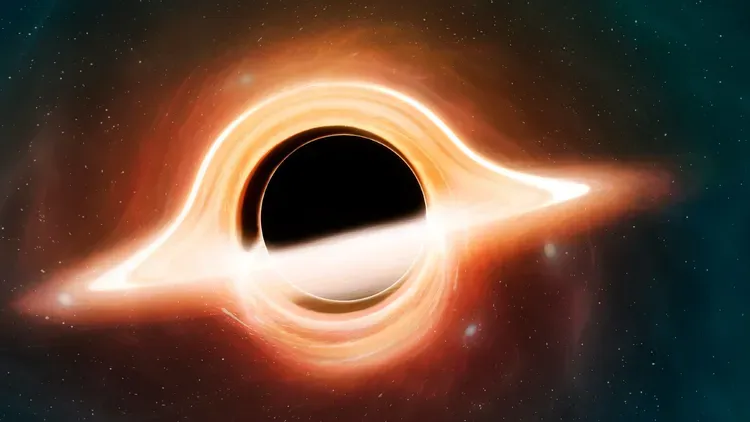
A black hole is a region of spacetime where gravity is so strong that nothing, not even light, can escape. The boundary where escape becomes impossible is the event horizon. Cross it, and every possible path through spacetime points inward. There is no “out” anymore.
Black holes form when a massive star runs out of fuel. Fusion in a star’s core pushes outward against gravity. When the fuel is gone, that outward pressure vanishes, and the star collapses under its own weight. If the remaining core is heavy enough, roughly three solar masses or more, the collapse doesn’t stop at a neutron star. It keeps going until all the mass is crushed into a point.
A common misconception: black holes are cosmic vacuum cleaners that suck everything nearby into them. They’re not. If the Sun were magically replaced by a black hole of equal mass, Earth’s orbit wouldn’t change. The gravitational pull at our distance would be identical. What changes is what happens up close, and that’s where things get strange.
One way to think about the event horizon: the escape velocity from any object depends on its mass and your distance from its centre. On Earth, it’s about 11 km/s. At the event horizon of a black hole, it exceeds the speed of light, roughly 300,000 km/s. Since nothing can travel faster than light, nothing can escape. The event horizon isn’t a physical surface. It’s a gravitational point of no return.
2. Falling In: What Kills You and When
Fall toward a black hole and two things will kill you, in this order: extreme time dilation distorts your sense of the world, then tidal forces strong enough to spaghettify you pull you apart. How far you get before that happens depends entirely on the hole’s mass. For a stellar-mass black hole, you die in open space before you ever reach the horizon.
The first thing you’d notice, assuming you had time to notice anything, is time dilation. Gravitational time dilation means that the stronger the gravitational field, the slower time passes relative to a distant observer. Near a black hole, this effect becomes extreme. Your watch ticks normally from your perspective. But to someone watching from far away, you slow down. Your movements stretch into slow motion. Your final second before the horizon, from the outside, takes an eternity.
Then come the tidal forces. Gravity follows an inverse-square law: it drops off with the square of the distance. Near a black hole, this gradient is brutal. Your feet, being closer to the black hole than your head, experience meaningfully stronger gravity. The difference in force between your feet and your head tries to pull you apart vertically while compressing you horizontally. This is spaghettification: you’re stretched into a long, thin strand of what used to be a person.
Whether you survive long enough to reach the event horizon depends on the black hole’s size. For a stellar-mass black hole (the kind formed from a collapsing star, maybe 10 solar masses) the tidal forces are so steep that you’d be spaghettified long before reaching the horizon. You die in space, not inside the black hole. For a supermassive black hole, like Sagittarius A* at the centre of the Milky Way (about 4 million solar masses), the event horizon is much farther from the singularity. The tidal gradient is gentler. You’d cross the horizon intact, with no physical sensation marking the transition, and only experience spaghettification much deeper in.
3. What an Observer Sees, or Doesn’t
The person falling in and the person watching from outside experience completely different realities, and both are physically valid. There’s no contradiction to resolve, just two frames of reference that general relativity treats as equally true.
From the outside observer’s perspective, you never cross the event horizon. As you approach it, gravitational time dilation becomes infinite — your clock, from their frame of reference, stops. Your image redshifts: the light leaving your body loses energy climbing out of the gravity well, shifting from visible light to infrared, then to radio wavelengths, then fading entirely. You appear to slow, freeze at the horizon’s edge, and gradually dim to black and you stay that way forever. The observer never sees you fall in. They see a fading photograph of your final moment, stretched across the entire future of the universe.
From your perspective, none of this happens. You cross the event horizon in finite proper time. You don’t feel a barrier, a jolt, or a sign that says “now entering: no return.” The universe outside the black hole would appear increasingly blueshifted and compressed into a shrinking circle above you, but you wouldn’t see yourself freeze. The outside world recedes into that shrinking circle until it disappears.
Neither account is the “real” one; relativity has no privileged frame of reference to settle the dispute. The event horizon isn’t a physical membrane. It’s a causal boundary. On one side, light can reach the rest of the universe. On the other, it can’t. And because information can only travel at light speed, that boundary is absolute.
4. The Singularity, and Why Physics Breaks Down There
If you survive spaghettification and cross the event horizon, general relativity says your worldline ends at the singularity — a point of infinite density and zero volume where the curvature of spacetime becomes infinite. The equations break. Physics, as we know it, stops making predictions.
Almost nobody thinks the singularity is physically real. Infinite anything in a physical theory is usually a sign that the theory is incomplete, that you’ve pushed it past its domain of validity. General relativity doesn’t incorporate quantum mechanics. At scales smaller than the Planck length (about 1.6 × 10^-35 metres), quantum effects should dominate, and we don’t have a working theory of quantum gravity to describe them. Whatever actually sits at the centre of a black hole (a Planck star, a firewall, something stranger), we don’t know.
This ignorance feeds directly into one of the deepest puzzles in theoretical physics: the black hole information paradox. Quantum mechanics says information cannot be destroyed. If you burn a book, the information in its pages is scrambled into the heat and ash, but in principle it’s still recoverable. A black hole appears to destroy information permanently. Matter falls in, and eventually, via Hawking radiation, the black hole evaporates. Where did the information go?
Stephen Hawking argued for decades that it was lost, which put him in direct conflict with the foundations of quantum mechanics. The current consensus leans toward information being preserved, encoded somehow in the Hawking radiation that leaks out over cosmic timescales, or imprinted on the event horizon itself. But the mechanism is unsettled. No experiment has resolved it, and no observation can reach inside a black hole to check. It remains, for now, a theoretical standoff.
5. White Holes, and Why None Have Ever Been Seen
If you take the equations of general relativity and run them backwards in time, a black hole becomes a white hole. Everything about it reverses: nothing can enter, everything must exit. Light and matter pour out. The event horizon becomes a one-way door in the opposite direction.
White holes are a legitimate mathematical solution to Einstein’s field equations. They’re not science fiction; the maths permits them. But here’s the problem: the maths also provides no known physical mechanism for one to form. A black hole forms from stellar collapse, matter crushing inward under gravity. A white hole would require matter to spontaneously explode outward from a singularity, which violates the second law of thermodynamics and every observation we have about how matter behaves. There’s no formation channel, no candidate object, and nothing in the sky that looks like one.
Some physicists have speculated that the Big Bang itself was a white hole, a singularity that ejected everything into existence. Others suggest that white holes might be the end state of black hole evaporation, popping into existence briefly at the end of a black hole’s life. Both ideas are speculative to the point of being almost unfalsifiable. White holes are more hypothetical than wormholes. At least wormholes arise naturally from certain solutions to the Einstein equations that don’t require running time backwards. White holes require that and a formation mechanism nature doesn’t seem to offer.
We’ve never seen one, and we probably never will. For now, they exist on paper and nowhere else.
6. The Nearest Black Hole Is 1,560 Light-Years Away
The nearest known black hole to Earth is Gaia BH1, discovered in 2022 by the Gaia spacecraft. It sits about 1,560 light-years away in the constellation Ophiuchus. It’s a stellar-mass black hole, roughly 10 times the mass of the Sun, orbiting a Sun-like star. We found it not by seeing the black hole itself (that’s impossible) but by watching its companion star wobble under an invisible gravitational pull.
1,560 light-years. Light, the fastest thing in existence, takes 1,560 years to travel that distance. Our fastest spacecraft, Voyager 1, has been travelling for 48 years and has covered about 0.0025 light-years, roughly 22 light-hours. At that pace, reaching Gaia BH1 would take about 29 million years. For context, 29 million years ago, the first apes hadn’t evolved yet. Whales still had legs.
We barely make it to our own Moon, which sits 1.3 light-seconds away. The Apollo astronauts spent three days getting there. The problem isn’t just speed, it’s energy. Each extra kilometre per second of velocity costs exponentially more fuel, and we have no propulsion technology that can deliver a human-scale payload to even the nearest star in less than thousands of years. Black holes, for all our fascination with them, are observation-only objects. We study them through telescopes, gravitational wave detectors and simulations. We will never visit one.
That’s not pessimism. It’s scale. And scale is the lesson black holes keep teaching: that the universe operates on dimensions the human mind was never built to grasp, and that standing at the edge of what we know is still standing very far away.