Most of the Universe Is Already Out of Reach
Somewhere out there, right now, a star is being born inside a galaxy whose light already fills our telescopes. We can see that galaxy. We have photographs of it. And yet no signal from that newborn star, no flash, no radio pulse, nothing it does today or for the rest of time, will ever reach us. Not because it sits too far away in the ordinary sense. If you could freeze the universe in place, light would cross the gap eventually, however long it took. The trouble is that the universe doesn’t hold still. The space between us and that galaxy is stretching faster than light can travel it, and it stretches a little faster every year.
In fact, most of the universe we can see is already beyond our reach, for good, and more of it slips away every second. But how can the universe be expanding faster than light?
Let’s start with what the expansion of the universe actually is, because it’ll only get wilder from there.
1. Expansion = space stretching
The universe is not expanding into anything, because there is no “anything” for it to expand into. What grows is space itself, everywhere at once.
The Big Bang was not an explosion that flung matter outward into an empty void. There was no center it blew up from, and there is no edge out at the frontier where the matter ends and the emptiness begins. There is no “outside”. The space inside the universe is all the space there is, and that space is the thing stretching.
Think of the surface of a balloon with dots inked onto it. Forget the inside of the balloon, and forget the air around it; forget everything but the rubber skin itself, and pretend that two-dimensional surface is the entire universe. When you inflate the balloon, every dot slides away from each other. There is no “center” anywhere on the surface, and there is no edge you could walk to and fall off. The surface has no boundary. Now the hard part: our universe does this in three dimensions instead of two, and you should not strain to picture what it expands into, because the whole point of the analogy is that the question has no answer. The balloon’s surface isn’t expanding into the air around it. In the analogy, that air doesn’t exist.
This is why “where did the Big Bang happen?” has the surprising answer: everywhere. Every point in the universe was crammed together in the dense early state, and every point has been spreading apart ever since. The Big Bang didn’t happen at a specific location in space. It happened to all of space. The galaxies receding from us this moment was, billions of years ago, almost on top of us, because back then all of space was smaller. Run the film backward and everything crowds together.
2. How fast the universe expands, and why galaxies outrun light
The expansion has a precise rate, and the rate follows one simple rule: the farther away something is, the faster it recedes. In 1929 Edwin Hubble, building on Georges Lemaître’s theory, measured exactly this. More space between you and a distant galaxy simply means faster recession.
where is how fast a galaxy recedes, is its distance, and (pronounced “H-naught”) is the Hubble constant, the factor that sets the rate today. Its measured value is roughly 70 kilometers per second per megaparsec. A megaparsec is about 3.26 million light-years. So the law says: for every 3.26 million light-years of extra distance, a galaxy’s recession speed climbs by another 70 km/s. A galaxy one megaparsec out drifts off at 70 km/s. One a hundred megaparsecs out recedes at 7,000 km/s. One a thousand megaparsecs out, 70,000 km/s.
Here comes the fun part.
Keep multiplying, and you will hit the light speed. Light travels at 300,000 km/s. Feed a large enough distance into Hubble’s law, and it returns a recession speed greater than that. Set and solve for the distance where it happens:
That distance is the Hubble radius. A galaxy sitting exactly there recedes from us at the speed of light right now. A galaxy past it recedes faster than light. And there are a great many galaxies that already had passed it.
2.1. Faster than light without breaking relativity
Special relativity is adamant that nothing travels through space faster than light, and that rule doesn’t get broken here, because nothing is actually moving through space here. The distant galaxy sits more or less still in its own patch of space. What grows is the distance between the patches, because new space keeps appearing between them (one way to think about it). Relativity’s speed limit governs motion through space. It says nothing about how fast space itself can stretch, and that has no limit at all.
You can sharpen the point until the apparent paradox dissolves. No observer ever sees anything overtake a light beam locally. Stand next to that faster-than-light galaxy and you’d find it sitting quietly in space, its starlight outrunning everything nearby exactly as relativity demands. The superluminal recession only shows up when you measure the distance between two far-apart points and watch that distance grow. No information crosses space faster than light, no spaceship outruns a photon, and nothing you send ever arrives ahead of its own light. The rule survives untouched. It simply never applied to the thing people assume it does.
3. Three horizons, three different distances
There are three different “edges” in the universe: the Hubble radius, the observable universe, and the cosmic event horizon. Take them in order of size.
3.1. The Hubble radius: where recession reaches light speed
We just met this one. At about 14 billion light-years, it is the distance where a galaxy’s recession speed equals the speed of light. The tempting assumption is that this marks the edge of what we can see, that galaxies past it have gone dark because they recede faster than their own light can reach us. That assumption is wrong, and why it’s wrong is the counterintuitive part: we routinely see galaxies that are, at this moment, receding faster than light.
3.2. The observable universe: everything whose light has arrived
The observable universe is everything whose light has had time to reach us since the Big Bang. Its radius is about 46.5 billion light-years, which makes it roughly 93 billion light-years across. That number alone is a puzzle, since the universe is only 13.8 billion years old. How can light have come from 46 billion light-years away? Because the space that light crossed kept expanding while it traveled. A photon that left a young galaxy 13 billion years ago has been swimming upstream through dough that rose under it the entire trip and the galaxy that emitted it has since been carried out to 46 billion light-years.
Notice that 46.5 is far larger than the Hubble radius of 14. That gap is the resolution to the paradox in 3.1. Light reaching us today from a galaxy near the edge of the observable universe set out long ago, when that galaxy was much closer and the space in between was expanding slowly enough for the light to make headway. The galaxy has since drifted out past the Hubble radius and now recedes faster than light, but its ancient light had already banked most of the journey and is only now arriving. So yes, we can photograph galaxies whose present-day recession speed exceeds the speed of light. We see them not as they are but as they were, and the “as they are” may already be unreachable. Which brings us to the third edge.
3.3. The cosmic event horizon: what we can never reach
The cosmic event horizon is the maximum distance from which a signal emitted now can ever reach us, even if we wait forever. This is because beyond the cosmic event horizon, the expansion of space prevents emitted photons/light from ever reaching us. That distance is defined as the cosmic event horizon, and sits at around 16 billion light-years (currently).
So the observable universe reaches out to 46.5 billion light-years, but the event horizon sits at 16. This means the sphere of things we can see is more than twice as wide as the sphere of things we can ever reach.
Everything in between that 16 and 46.5 is visible to us and forever beyond our reach at the same time. We only see those galaxies’ ancient light. We will never know what they are doing now. We can never send them anything, or receive anything they emit from this moment onward. A message we transmit today, riding outward at light speed forever, simply would never reach them.
The reachable sphere of 16 billion light-years is a small fraction of the visible sphere of 46.5. Cube the ratio of the radii and you’ll find that about 95% of the galaxies in the observable universe already lie past the event horizon. Most of what we can see, we have already lost forever. We just have some photographs.
4. Why the horizon exists, and how galaxies vanish
The event horizon exists because the expansion is accelerating. This was the great surprise of 1998. Two teams measuring distant supernovae expected to clock the expansion gradually decelerating under gravity’s pull. Instead they found it accelerating, as though something were pushing space apart harder and harder as time went on. That something got the placeholder name dark energy. We know it makes up about 68% of the universe and we know what it does, but not what it really is.
Acceleration also changes the way a galaxy disappears, and the way it disappears is not what you’d expect. A galaxy crossing the event horizon does not wink out like a switched-off bulb. As the space between us and it stretches faster and faster, the light it sends gets stretched along with it, its wavelength dragged longer and longer, its color sliding from visible toward red, then past red into infrared, microwave, radio, and onward. This is cosmological redshift, and near the horizon it runs away toward infinity.
The galaxy dims and reddens and appears to slow, its final image frozen and fading at the threshold, the last photons it will ever send us spread so thin and shifted so far that no instrument could register them. It doesn’t leave so much as fade to black while seeming to hang almost motionless at the edge, lost not because it moved away but because its light ran out of energy climbing toward us.
4.1. The far future: an empty sky
Push this forward and the far future of the universe turns lonely in a precise, measurable way. The Local Group, our gravitationally bound cluster of the Milky Way, Andromeda, and a few dozen smaller galaxies, holds itself together against the expansion. Inside a bound system, gravity beats the cosmic stretch, so these galaxies are not receding from one another and never will (in fact, we are on a collision course with the Andromeda Galaxy). However, everything outside this Local Group is another story.
One by one, over the next hundred billion years or so, every external galaxy will redshift across the event horizon and vanish from view.
By the time that’s finished, a civilization on some world among the merged remains of the Milky Way and Andromeda, sometimes nicknamed Milkomeda, will look out and see a single island of stars surrounded by featureless black. They will see no other galaxies, and no cosmic microwave background either, because that relic glow of the Big Bang will also have stretched beyond any hope of detection. Their finest telescopes will show them a static, eternal, solitary universe of one galaxy, and every measurement they can make will agree (assuming the limitations of our current technology). They will have no way to learn that the universe is expanding or that it ever began, and they will have no way to find that the two trillion other galaxies used to hang overhead.
There is a sobering thought folded into that. We are not staring at an old universe with a rich, permanent record. We are living in a narrow window when the evidence is still here to read. The cosmological story is legible right now, but it has an expiration date. Set that beside the fact that, measured against the universe’s full lifespan, we are also absurdly early to all of it.
5. So is the universe finite? We genuinely don’t know
The observable universe is finite. Whether the whole universe is finite, we do not know, and we may never. Everything in this post so far has concerned the observable part; the 93-billion-light-year sphere of stuff whose light has reached us. But it’s only a patch, the part we can see, and the obvious question is what lies past it. After a century of cosmology and instruments that can read the temperature of the sky to a millionth of a degree, the honest answer is a shrug.
The thing we can actually measure is the geometry of space: whether it’s curved, and which way. Curvature is easiest to picture in two dimensions. A flat sheet of paper has none; the surface of the balloon from section one is curved all over. General relativity lets the three-dimensional space curve in that same sense on large scales, and it allows exactly three possibilities. Space can be positively curved, closing back on itself like the balloon’s surface. It can be negatively curved, flaring open like a saddle. Or it can be flat, the everyday geometry where parallel lines stay parallel and a triangle’s angles add up to 180 degrees. Which one we live in bears directly on whether the universe is finite or infinite. The problem is, we can’t measure it precisely enough.
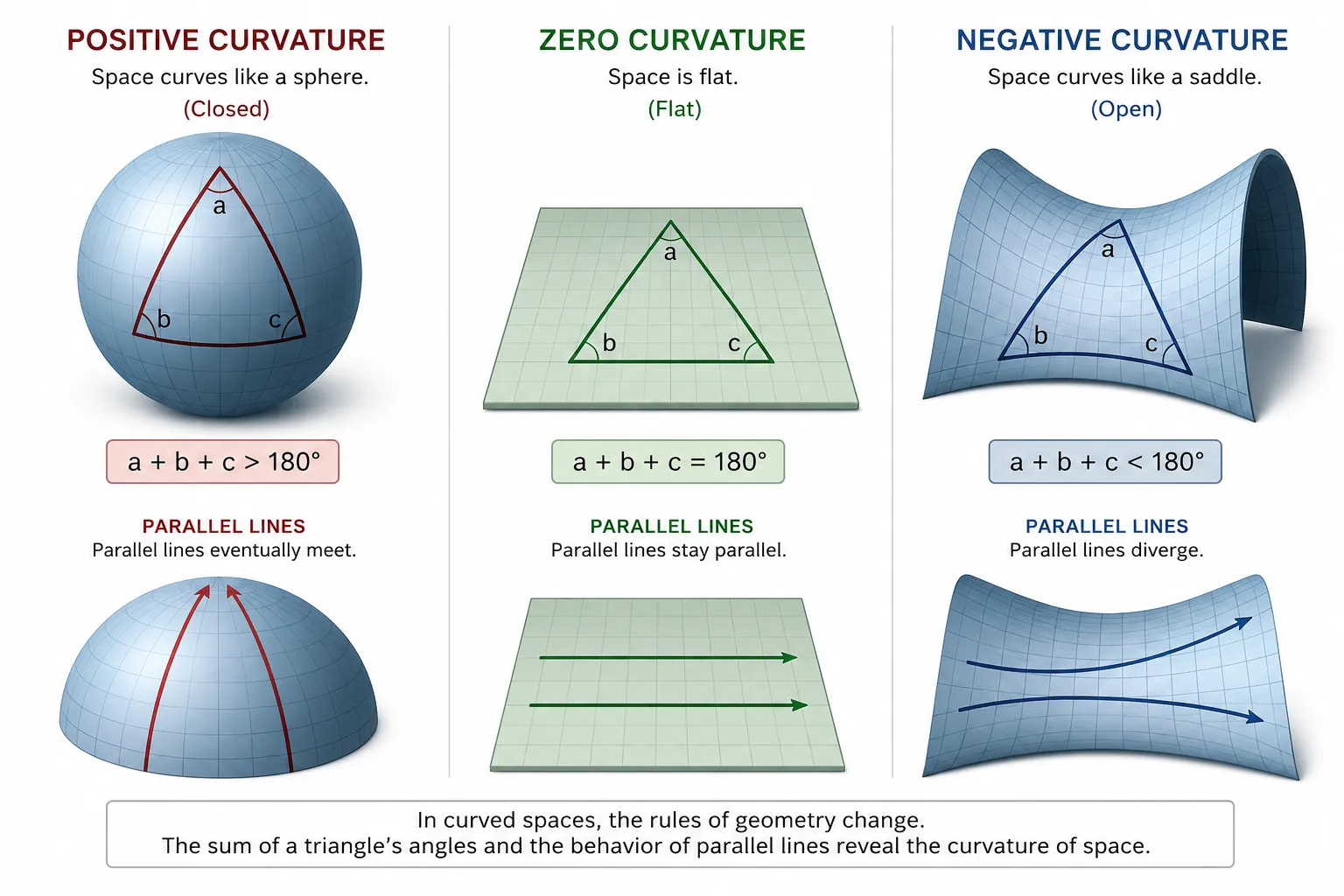
You can tell the three apart by drawing a big triangle and adding up its corners. In flat space they sum to exactly 180 degrees; on a sphere they sum to more, on a saddle to less, and the larger the triangle, the more the difference shows. Cosmologists run a version of this test on the whole sky. The cosmic microwave background, the faint leftover glow of the Big Bang, is speckled with hot and cold patches whose true size physics can predict. Measure how large those patches actually appear to us, compare that against the predicted size, and any mismatch betrays the curvature of the space their light crossed on the way here.
The measurements, chiefly from the Planck satellite (a European spacecraft that spent four years mapping that ancient glow in fine detail), come back flat. Not perfectly flat, since no measurement is exact, but flat to within about 0.5%. And that’s the problem. In the simplest models, a flat or negatively curved universe is spatially infinite, running on forever in every direction with no edge and no repetition, while a positively curved one is finite. Half a percent of slack is nowhere near enough to tell a perfectly flat, infinite universe from one curved so gently that it closes up on a scale thousands of times larger than anything we can observe. The data is consistent with infinite, and it is also consistent with finite-but-extremely-large. We currently can’t tell which is the case with confidence.
5.1. A finite universe still has no edge
Here is the part that closes the loop back to the beginning. Suppose the universe is finite. People hear that and picture a boundary, a place where space stops and you would hit a wall, or an edge you could lean over. There is no such thing, and the balloon from section one already showed why. The surface of a balloon is finite; it has a definite area you could measure. But it has no edge. Walk in any direction and you never reach a boundary, you just eventually arrive back where you started. A finite universe works the same way in three dimensions. It would have a finite volume and no edge, no wall, no outside. Travel far enough in a straight line and you would return to your starting point, having circled the cosmos the way a ship circles the Earth.
So the two live options really are an infinite universe with no edge, or a finite universe with no edge. Notice that there is no boundary in either answer. Space is the whole stage. It either runs on without end, or it loops back on itself.
And we may be stuck not knowing which, permanently. The one tool that could settle it, seeing far enough to catch the universe curving back on itself or repeating, is exactly the tool the event horizon is taking away. The decisive evidence, if it exists at all, sits in regions the expansion has already carried beyond reach. We are trying to measure the shape of something while most of it disappears over the horizon, and the disappearing is only getting faster.